Events
Medellín Encuentro
In April 2026, a two-day encuentro brought together participants from different social families searching for disappeared loved ones, including Casa Diversa – Comuna 8, AMCV (Asociación de Mujeres Caminando por la Verdad), and Mujeres Desde Adentro. Alongside artists and partner organizations in Medellín, women and sex and gender dissident people from these distinct social families came together in a shared space of listening, exchange, and collective care, while bringing their own histories, experiences, and practices of búsqueda.
Rather than documenting the encuentro itself, this section brings together two collaborative processes that offer different ways of engaging with búsqueda: reflections on everyday search practices shared during the encuentro and the collective creation of cartotejidos. Together, they intent to lluminate the relationships among sonic memory, care, territory, relational listening, and the everyday practices of búsqueda.
For readers interested in the broader conversations, methodologies, and reflections that shaped both the Medellín and Bogotá encuentros, the booklet Sonic Territories of Search: Memory and Radical Listening with Mujeres Buscadoras in Medellín and Bogotá is available in the archive resources section.
Everyday Search Practices

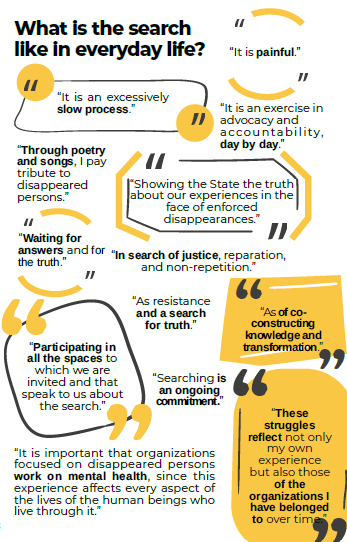
Searching for disappeared loved ones extends far beyond institutional or judicial processes. During the Medellín encuentro, participants shared and reflected on the everyday practices through which búsqueda is sustained. Walking memory routes through conflict-affected neighbourhoods and geographies shaped by violence, creating and sustaining affective archives in relation, intervening photographs and stones, weaving, writing poetry, singing, playing theatre, placing sunflowers at the Río Medellín, and accompanying one another are practices through which memory, care, and relationships with disappeared loved ones continue. In these everyday practices, mountains, rivers, stones, gardens, neighbourhoods, and other more-than-human territories sustain relationships with disappeared loved ones, making their presence felt while enabling diverse social families of searchers, including women and sex and gender dissident people, to continue living, searching, caring, and resisting together.
Cartotejidos: Weaving Collective Sonic Cartographies
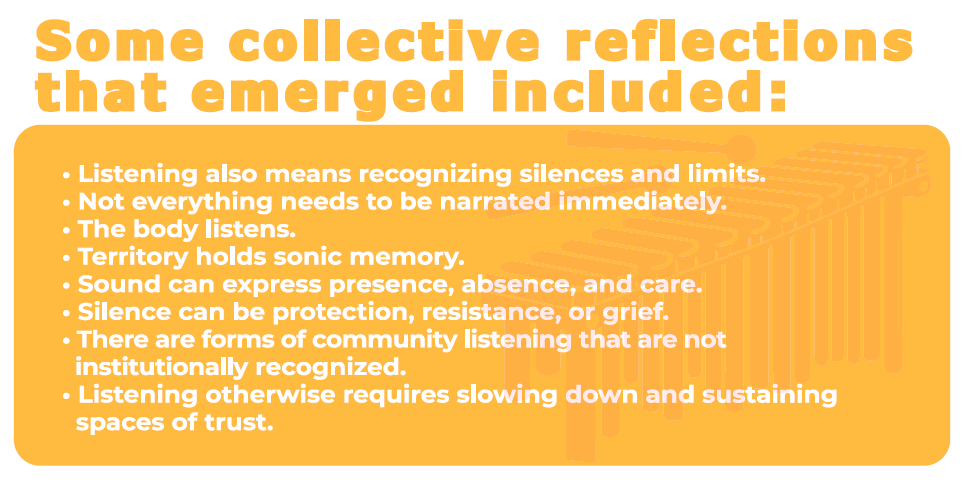
Through the collaborative creation of three cartotejidos, participants from Casa Diversa, AMCV, and Mujeres Desde Adentro brought together practices of junte (coming together through collective care) and tejer (weaving relationships and memory). Across different histories and experiences of búsqueda, they created spaces for listening, exchange, and mutual learning, weaving together knowledges, sonic territorial memories, and relationships that sustain everyday practices of searching within and across social families of searchers.
Created with cardboard, fabrics, drawings, embroidery, and thread, the cartotejidos weave together places, journeys, and sonic territories shaped through búsqueda. Mountains, flowers, pathways, footprints, and human silhouettes insist on the presence of their disappeared loved ones despite their absence, while bearing witness to the bodies of the social families of searchers who continue to walk neighbourhoods, mountains, and riverbanks in search of truth, memory, and justice. Woven through these territories are voices, poems, songs, footsteps, the echoes of gunfire, children flying kites, flowing water, noise, and silence. Together, they invite a practice of listening that attends to the everyday sonic territories of búsqueda and to the human and more-than-human relationships through which searching, memory, and collective care endure.
More than representations of place, the cartotejidos trace the everyday sonic and territorial relationships that emerge through searching: between bodies and territories, memory and sound, absence and presence, junte and tejer. They invite visitors to encounter búsqueda as a collective, relational, ongoing, and more-than-human territorial practice. The accompanying recordings, poem, and videos can be explored in the archive resources section.
Bogotá Encuentro
In May 2026, a one-day encuentro brought together members of La COMADRE (Coordination of Displaced Afro-Colombian Women in Resistance) in Bogotá. Rooted in Afro-Colombian territorial and ancestral knowledges, histories of resistance, and communal practices of memory of the group, the encuentro opened a shared space for listening, dialogue, exchange, collective reflection, and ethical return. Together, participants reflected on búsqueda, remembrance, relational care, and the enduring relationships through which Afro-Colombian communities continue to sustain memory and life across diverse territories.
Rather than documenting the encuentro itself, this section centres on Afro-sonic territories as a way of engaging with la búsqueda carried by women of La COMADRE for their disappeared loved ones. The encuentro also opened a space for ethical return and conversations around La COMADRE's memory arts, including theatre, kútrus, healing ritual practices, painting, and their travelling exhibition. While these practices remain integral to La COMADRE's work, this archive dwells with Afro-sonic territories and the collective oral and sonic cartographies through which sound, territory, ancestral memory, and relationships among human and more-than-human worlds continue to nurture memory, collective care, resistance and the everyday practices of re-existence and la búsqueda.
For readers interested in the broader conversations, methodologies, and reflections that shaped both the Bogotá and Medellín encuentros, the booklet Sonic Territories of Search: Memory and Radical Listening with Mujeres Buscadoras in Medellín and Bogotá is available in the archive resources section.
Afro-Sonic Territories
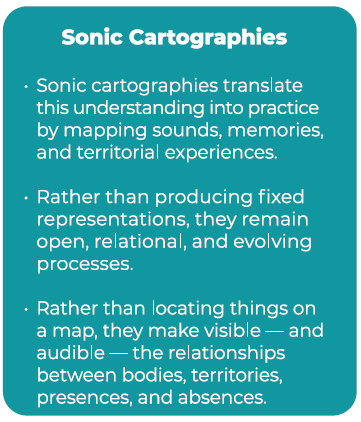
During the Bogotá encuentro, members of La COMADRE collectively created Afro-sonic cartographies woven not through paper, thread, or needles, but through the Black sonic-territorial-oral materialities of Afro-Colombian re-existence shaped by enduring histories of resistance. Women shared songs from their territories, played percussion instruments they had brought with them, recited their own poetry, and listened together. Rhythm, voice, territorial vibrations, the sounds and silences of river worlds, and shared listening became the living materials from which these cartographies emerged. Drawing on the ancestral, territorial, and living knowledges of displaced Afro-Colombian women from Tumaco, Chocó, and other Afro-Colombian territories across Colombia, they made present their cuerpas-territorios (understanding the body as inseparable from territory, memory, and lived experience), their disappeared loved ones, and histories of displacement, care, resistance, and joy rooted in Afro-Colombian and Afro-diasporic life.
To listen with these Afro-sonic territories is to encounter la búsqueda as a relational practice resonating across voices, bodies, rivers, forests, lands, ancestors, and human and more-than-human worlds, while remaining grounded in the specific histories and territories of Black Afro-Colombian resistance and re-existence.
Music, orality, rhythm, vibration, and ancestral spiritual practices are living practices through which memory, spirituality, collective care, and the everyday practices of la búsqueda are sustained. As members of La COMADRE reflected throughout the encuentro, singing, drumming, storytelling, and shared listening nurture collective joy, making it possible to sustain life amid everyday and structural racism, territorial dispossession, displacement, and enforced disappearance. Through comadreo, shared listening, and collective sonic-territorial-oral practices, Afro-sonic territories sustain relations among ancestors, disappeared loved ones, communities, lands, rivers, forests, and human and more-than-human worlds, affirming life while sustaining the grammars of futures rooted in dignity, memory, and collective care.
These materials invite visitors to listen with Afro-sonic territories through relational listening grounded in Afro-Colombian ancestral knowledges, territorial memories, and communal practices. Rather than offering a complete account, they invite us to dwell with the sonic and infrasonic relations through which territorial memory, collective care, and the everyday practices of la búsqueda are woven. As voices, rhythms, rivers, silences, and ancestral knowledges resonate in polyphony, they reveal how the disappearance of loved ones is inseparable from the intersecting violences shaping the lives of Black Afro-Colombian women, including racism, forced displacement, territorial dispossession, and gendered violence. Through their practices of remembering, caring, resisting, and making present those who are absent, they reveal la búsqueda as a pluriversal practice that sustains Black Afro-Colombian re-existence from Bogotá and across their territories in Colombia, while encountering other territories, communities, and worlds.